Designing Commercial-Grade Gloss Doors with Confidence
High-gloss cabinet doors can make a space look clean, sharp, and modern. That shine also works like a mirror, which means it shows every bump, chip, and misalignment. For commercial projects, that is not just a design problem; it is a performance problem.
When we talk about commercial-grade high-gloss cabinet doors, we mean doors with consistent sheen, strong impact resistance, and long-term stability in busy spaces. Think rental units, retail fixtures, office millwork, and multi-residential amenity areas that see constant use. Getting that level of performance starts at the specification stage, long before the first door is hung.
Details like substrate, edge-banding, and installation tolerances are where most projects succeed or struggle. If these are vague or left to chance, you can end up with warping, telegraphing through the gloss, chipped edges, and misaligned reveals that stand out under strong lighting. Clear and repeatable specs help avoid call-backs and keep future phases consistent.
At M+J Woodcrafts, we focus on precision-made custom cabinet doors. Our goal is to help design and construction teams turn glossy concepts into real, durable, and repeatable cabinet door solutions that work across multiple sites and phases.
Choosing the Right Substrate for High-Gloss Performance
The substrate is the backbone of every high-gloss cabinet door. Gloss loves a flat, stable, smooth base. Any flaws in the core tend to show through the finish.
Common substrates include:
- MDF
- Particleboard
- Specialty cores or moisture-resistant grades
MDF is often preferred for painted and 3D laminate high-gloss doors because it machines cleanly, holds a profile well, and has a smooth surface. Particleboard can be a strong option for flat laminate high-gloss doors, especially where screw-holding and cost balance are important. Specialty cores and higher-density options come into play when you need extra stability for larger doors or challenging environments.
Key substrate factors for high-gloss cabinet doors:
- Flatness and thickness tolerance
- Density and screw-holding
- Surface smoothness for bonding and painting
- How well it runs on CNC and other automated equipment
In Canadian construction, moisture and humidity can shift a lot from summer into fall. Doors that are not acclimated or that sit in damp conditions can move or deflect, which shows up as twist or uneven reveals. Good practice is to:
- Allow doors to acclimate to site conditions before installation
- Store them flat, off the floor, and away from direct moisture
- Avoid installing into spaces that are still very wet from recent work
Substrate choice can help manage this seasonal movement. Denser, more stable cores tend to resist bowing and keep larger doors flatter over time, which is important when light rakes across a glossy bank of panels.
At M+J Woodcrafts, we pay close attention to core density, thickness, and surface quality. Consistent cores help us machine to tight tolerances, support mirror-like gloss levels, and keep door thickness uniform so hardware and reveals line up from batch to batch.
Matching High-Gloss Finishes to Substrate and Use
Once the substrate is right, the next step is choosing the finish system. Not all high-gloss finishes behave the same way, and each type interacts with the substrate in its own way.
Broadly, we work with:
- 3D laminate cabinet doors
- Flat laminate high-gloss doors
- Painted high-gloss finishes
3D laminate cabinet doors use a thermoformed film that wraps the face and edges of a routed MDF core. This gives a seamless look around the profile, strong edge protection, and good impact resistance, since there is no separate band at the edge.
Flat laminate high-gloss doors use a high-gloss laminate on the face of a stable core, matched with edge-banding. This is suited to clean, flat designs, where abrasion resistance and a hard surface are priorities.
Painted high-gloss doors offer deep colour and a refined feel. They depend heavily on substrate smoothness and careful finishing to keep that mirror look without orange peel or telegraphing. They can be a strong fit for higher-end residential and feature areas in commercial projects.
When aligning finish choice with project type, think about:
- Rental or hospitality: focus on impact and abrasion resistance and forgiving edges
- Healthcare or office: focus on cleanability and resistance to common cleaners
- Higher-end residential or amenity: focus on colour depth, sheen level, and touch
Finish consistency is another big factor on commercial work. Designers and builders often need the same white or the same wood tone to repeat over several phases. At M+J Woodcrafts, we work to maintain colour and gloss control from batch to batch so you can confidently reuse the same specification on future stages of a development without worrying about visible shifts.
Edge-Banding Strategies That Protect the Gloss Aesthetic
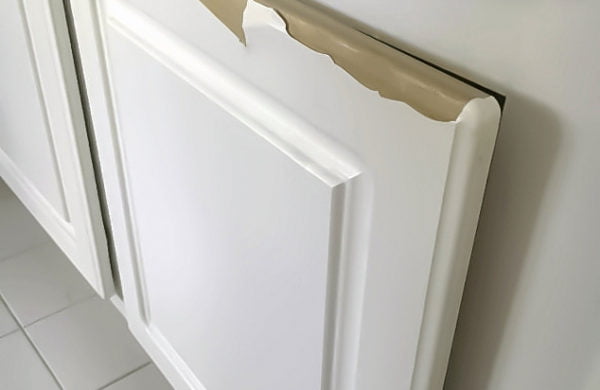
On high-gloss cabinet doors, the edges are where reality often fails the rendering. Poorly chosen or poorly applied edge-banding can make a premium finish look cheap.
Common edge-banding options include:
- ABS
- PVC
- Acrylic or 3D edge banding
Banding thickness affects both look and durability. Thicker banding can improve impact resistance and give a sense of quality, especially at high-touch points like base cabinets and tall pantry doors. Thinner banding can work for upper doors where impact is lighter, but it still needs to be well bonded.
Key edge details to think about:
- Radius or profile at the edge; sharp edges chip more easily
- Banding thickness for impact zones vs light-use areas
- Colour and print match to the face, including direction of any grain
- How the edge reflects light beside the glossy face
High-gloss surfaces show the line between face and edge clearly if it is not done well. Poor colour match or a visible glue line can break up the reflection and make doors look uneven. In some cases, banding that is too thin or too light can let the substrate show at corners over time.
We use precise edge-banding equipment, colour-matched materials, and close quality checks to keep seams tight and corners clean. The goal is a continuous, uninterrupted look so the gloss reads as one surface, even under strong lighting and over years of use.
Installation Tolerances for High-Gloss Doors That Stay True
Even perfectly made doors can look wrong if installation is loose. High-gloss cabinet doors highlight misalignment in a way matte finishes simply do not. Light will run along a gloss bank and make any twist, uneven gap, or stepped door jump out.
That is why clear tolerances and good hardware specs matter. You will want to define:
- Allowable bow and warp limits based on door size
- Size tolerances for door height and width
- Hinge type and the range of adjustment in three directions
Concealed hinges with generous adjustability help installers tune the reveals so verticals are straight and horizontals line up across runs. Minor movement over time can then be corrected without replacing doors.
At M+J Woodcrafts, we manufacture doors to tight dimensional tolerances and prep them for modern hinge systems. Consistent sizing across batches helps installers on larger projects, because they can trust that doors from different production runs will still align with existing cabinetry and hardware layouts.
Specify M+J High-Gloss Doors With Confidence on Every Project
When substrate, finish system, edge-banding, and installation tolerances all work together, you get high-gloss cabinet doors that look sharp on day one and keep that look over years of commercial use. Clean reflections, straight lines, and durable edges all come back to the details set early in the specification.
Designers, architects, builders, developers, millwork shops, and homeowners choose M+J Woodcrafts because we focus on these details. As a Canadian manufacturer of custom cabinet doors, we bring material knowledge, repeatable production processes, and finish consistency that help teams standardize a high-gloss specification and reuse it across phases and properties. By locking in the core, finish, edge, and tolerance requirements with us, you can rely on a proven, commercial-grade high-gloss cabinet door solution whenever the next project calls for that polished look.
Get Started With Your Project Today
If you are ready to update your space with a sleek, contemporary look, our high-gloss cabinet doors are a durable, low-maintenance choice tailored to your needs. At M+J Woodcrafts, we work with you to match finishes, sizes, and details so your cabinets fit seamlessly into your project. Share your measurements, ideas, or drawings and we will help you choose the right options. Have questions about timelines or custom work, or need a quote started today? Simply contact us and our team will follow up with clear next steps.