Humidity, salt air, and temperature swings are tough on cabinet doors. In coastal homes, busy commercial washrooms, and bathrooms with frequent showers, moisture hangs in the air and settles on every surface. Over time it can cause swelling, warping, and finish problems that change how doors look and work.
In this article, we explain how humidity affects different door constructions, why thermofoil doors are a strong option for these interiors, and what good engineering and installation can do for long-term performance. Our goal is to help design teams, builders, millwork shops, and homeowners plan with confidence, without giving up on the look they want.
Designing for Humidity Without Limiting Your Vision
High humidity and coastal conditions are hard on cabinet doors in both homes and commercial spaces. Moisture works its way into joints and edges, so you see:
- Swelling along edges and around hardware
- Warping or twisting that throws off reveals
- Delamination where layers separate
- Finish breakdown, from peeling to hairline cracks
This can be especially noticeable around sinks, dishwashers, bathroom vanities, and in coastal interiors where salty air is part of daily life.
Thermofoil doors give a strong balance of performance and design flexibility when they are properly engineered, manufactured, and installed for moisture exposure. You can still specify clean modern slabs, classic shaker looks, or subtle profiles without defaulting to options that are more likely to move or crack under humidity changes.
At M+J Woodcrafts, we focus on cabinet doors, not full cabinets. We specialize in thermofoil, laminate, and painted doors, and we pay close attention to how each material behaves in real project conditions, including coastal and high-humidity interiors across Canada and beyond.
How Humidity and Coastal Air Impact Cabinet Doors
Humidity is simply water vapour in the air. When relative humidity goes up, wood-based materials pick up moisture and expand. When it drops, they give off moisture and shrink. Near the coast, salt particles in the air add another stress factor for finishes and hardware. Temperature swings, especially when spaces are opened and closed through late summer, push this expansion and contraction cycle faster.
Different door constructions respond in different ways:
- Solid wood: Moves across the grain, so wide rails and stiles can cup or twist, and joints can crack at the corners.
- Wood veneer on cores: Sensitive to moisture at edges and seams, where veneer can bubble or lift if moisture reaches the glue line.
- Painted MDF: Stable in thickness, but sharp profiles and joints can show hairline cracks or paint chipping as the substrate moves.
- Engineered cores: More stable than solid wood, but still need proper sealing and finish systems to keep humidity out of weak points.
The failure modes designers and builders work to avoid in humid interiors include:
- Edge swelling, especially on bottom edges of sink and vanity doors
- Joint cracking on painted shaker profiles
- Finish peeling around dishwashers, laundry units, and showers
- Substrate breakdown where water pools or steam vents directly onto the doors
Understanding these risks is the first step to picking a material and door construction that will perform well in each zone.
What Makes Thermofoil Doors Suitable for Humid Interiors
A thermofoil door is typically an engineered core, often MDF, wrapped in a heat-formed PVC or similar film. Under controlled heat and pressure, the film bonds to the face and profile of the door, creating a continuous surface with no painted joints on the front.
For humid and coastal interiors, this construction offers several advantages:
- Strong resistance to surface moisture on the faces and profiles
- A consistent, uniform finish with no grain variation to telegraph movement
- Reduced risk of hairline cracks compared with some painted systems, since there are no paint lines on the face joints
- Easy-to-clean surfaces that stand up well to everyday wiping and splashes
However, not all thermofoil doors perform the same. Quality comes from how the door is engineered and manufactured. Key variables include:
- Substrate selection: The type and grade of MDF or other core, and its density and moisture behaviour.
- Adhesive performance: The glue system used to bond film to the core, and how it is matched to the foil and project conditions.
- Press calibration: Temperature, pressure, and cycle timing tuned for reliable film bonding.
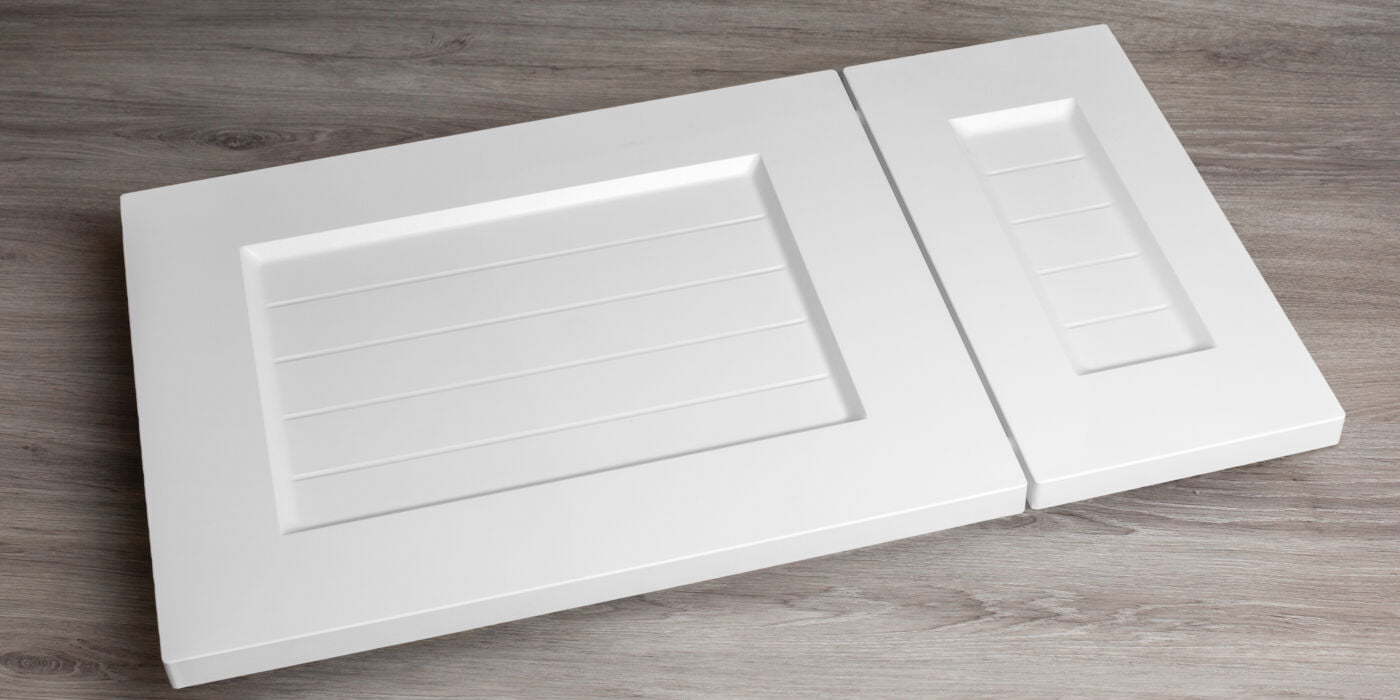
- Profile design: Radii and grooves shaped to allow the film to wrap without overstretching or thinning.
- Edge wrapping and machining: Clean, consistent edges and corners to limit weak points for moisture ingress.
An experienced manufacturer manages all of these steps, so the thermofoil doors are better prepared for humidity, not just good-looking on day one.
Engineering Thermofoil Doors for Coastal and Bathroom Projects
Design choices play a major role in how well thermofoil doors stand up in humidity-prone spaces. Some thoughtful decisions include:
- Selecting profiles with gentle radii instead of extremely sharp cuts that stress the film
- Choosing panel styles that avoid deep, tight inside corners where moisture and cleaning solutions can sit
- Planning doors so high-exposure areas, such as under sinks or in public washrooms, use profiles proven to perform well in those conditions
At M+J Woodcrafts, we engineer thermofoil doors with performance in mind. Our process includes:
- Controlled manufacturing environments for consistent temperature and humidity during pressing
- Precise press cycles tuned to the specific foil and substrate combination
- Consistent, monitored adhesive application so glue lines remain strong and uniform
- Quality checks that focus on bond integrity, corner wrapping, and surface uniformity
For real-world use, thermofoil doors can be a strong choice in:
- Coastal kitchens and bathrooms, where regular salt air and high humidity are the norm
- Rental units and multifamily developments, where durability and easy cleaning are priorities
- Commercial washrooms and staff spaces, where frequent cleaning and steam can be expected
Around high-heat appliances, such as wall ovens or certain specialty units, it often makes sense to pair thermofoil doors with other materials or to use filler panels and trims designed for that heat zone. A coordinated material plan keeps the whole millwork package working together.
Detailing, Ventilation, and Installation That Protect Your Investment
Even the best thermofoil door needs proper detailing and installation. Small choices on site can have a big impact over time. Installers should:
- Maintain proper clearances around appliances and fixtures so doors do not rub or bind
- Avoid placing doors in direct contact with steam vents or continuous heat sources
- Protect door edges next to sinks and dishwashers with thoughtful layout and, where needed, trims or gables
- Confirm that dishwashers and other steam-producing appliances are vented correctly
Interior climate control matters too. In late summer, humidity can stay high even when temperatures begin to drop overnight. Good ventilation and balanced HVAC reduce stress on all cabinet doors by smoothing out rapid swings in humidity.
Our focus on dimensional consistency and repeatable manufacturing helps here. When doors are consistent in size, flatness, and drilling, millwork shops and installers can set precise reveals and hardware layouts. That reduces binding, rubbing, and uneven wear, which can speed up moisture-related issues.
Why Design Teams Choose M+J for Humid and Coastal Projects
For humid and coastal interiors, many design teams choose thermofoil doors for a mix of performance and design freedom. The key benefits of specifying well-made thermofoil include:
- Reliable resistance to everyday surface moisture in kitchens, bathrooms, and coastal spaces
- Finish consistency across large programs, so units in one phase match later phases
- A broad design palette of colours and textures to support both residential and commercial concepts
From a professional specifier’s perspective, M+J Woodcrafts brings a focus on cabinet door manufacturing that supports demanding projects. We work with stable, quality materials, run controlled production processes, and pay close attention to colour and texture matching across repeat orders. That makes thermofoil doors a dependable option for multi-unit and multi-phase developments, as well as custom residential work.
By involving our team early on style selection, thermofoil choice, and performance requirements, designers, architects, builders, developers, millwork shops, and homeowners can plan interiors that are both visually cohesive and ready for humidity, coastal air, and daily use.
Elevate Your Cabinets With Durable, Custom Thermofoil Solutions
Upgrade your kitchen or bathroom with our high-quality thermofoil doors, crafted to deliver long-lasting style and everyday practicality. At M+J Woodcrafts, we work with you to ensure the profiles, colours, and details match your vision and project needs. If you are ready to move forward or have questions about specifications, reach out through our contact page so we can help you plan the next steps.