Designing Commercial Cabinet Doors for Real-World Use
Commercial cabinet doors work hard. In retail, healthcare, hospitality, education, and office spaces, they are opened, closed, kicked, bumped and wiped down all day. If the doors and their hardware are not planned for that level of use, problems show up fast: misaligned fronts, chipped edges, peeling finishes and doors that never seem to close quite right.
That is why hardware and edge protection deserve the same attention as style, core and finish. A durable thermofoil or laminate cabinet door still needs hinges, pulls and edge details that match how the space will actually be used. When those pieces are planned together from the start, project teams can cut down on repairs, protect their design intent and get longer life from every commercial cabinet door.
At M+J Woodcrafts, we see commercial cabinet doors as systems. The door construction, finish, hardware machining and edge treatment all work together. This article walks through how each part supports the others in busy, high-traffic interiors.
How Traffic, Cleaning and Codes Shape Hardware Choices
Commercial spaces put cabinet doors through what many residential projects never see. Think about a typical day:
- Staff opening the same storage doors every few minutes
- Heavy carts and equipment bumping into lower doors and exposed corners
- Frequent cleaning with commercial chemicals and disinfectants
- Seasonal humidity swings in Canadian climates affecting alignment and movement
All of this shapes hardware decisions long before installation. Designers and builders need to consider:
- Accessibility: Pull sizes, locations and opening forces that support accessible use
- Noise control: Soft-close hinges and dampers in offices, clinics and hospitality spaces
- Security needs: Lock locations in healthcare and education where controlled access matters
- On-site adjustability: Hinges with easy adjustment to correct for building movement and minor shifts
Commercial cabinet doors also tend to be larger, especially in storage rooms, corridors and healthcare work areas. Taller and wider doors put more load on the hinges. If hinge positions and pull locations are not planned into the door construction from the manufacturing stage, screws can end up in weak zones and the door corners can twist or sag.
By treating hinge and pull layouts as part of the door design, not an afterthought, the door substrate can be set up to support those loads. This is especially important with high-performance thermofoil and laminate cabinet doors, where consistent performance depends on stable construction under the finish.
Hardware Strategies That Protect Commercial Cabinet Doors
The right hardware can help protect cabinet doors from daily abuse instead of adding stress to the door.
Hinge selection affects:
- How much weight the door can carry over time
- How smoothly and quietly doors operate under frequent use
- How much stress is passed into the hinge area and finish
Accurate hinge cup boring and strong screw engagement are key. If the hinge cup is off by even a small amount, or screws sit in a weak area of the substrate, you see problems like:
- Doors that will not stay aligned after adjustment
- Corners that pull away under heavy use
- Stress cracks in the finish around hinge areas
Soft-close options are another simple way to protect thermofoil and laminate finishes. Slamming doors sends shock through the hinge area and the door surface. Soft-close hinges spread that impact out over time, cutting down on sudden stress that can lead to long-term wear.
Pull and handle choices matter as well. In commercial spaces, it often makes sense to choose:
- Longer pulls that are easier to use with gloves or full hands
- Back-to-back pulls on tall doors to reduce twisting force
- Edge pulls or finger pulls that limit direct contact with the door face
Good hardware layout is only as reliable as the drilling and machining behind it. Consistent boring patterns, correct setbacks and reinforcement where needed support performance across large multi-unit projects. At M+J Woodcrafts, we focus on precision machining so hardware performs the same way from the first door to the last in a run.
Edge Protection Tactics for High-Traffic Interiors
Edges and corners are often the first parts of commercial cabinet doors to show wear. Risk areas include:
- Exposed corners in hallways and tight corridors
- Lower doors near floor-cleaning equipment and rolling carts
- Ends of long cabinet runs that get repeated side impacts
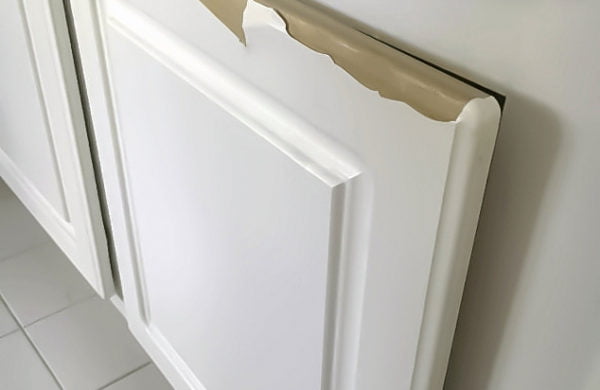
If edges are not protected, you can see chipping, delamination and water ingress from regular cleaning. In Canadian climates, where humidity and temperature shift with the seasons, any moisture that gets into an edge can expand and contract over time.
Common edge protection strategies include:
- Edge banding on laminate cabinet doors
- 3D laminate wrapping on thermofoil cabinet doors for a continuous surface
- Postformed laminate shapes for smooth, curved fronts
- Separate trim or bumper systems at high-risk corners and corridor ends
Each approach has its place. Wrapped or postformed edges help seal the substrate and reduce places for water and chemicals to get in. Edge banding gives flexibility in colour and thickness. Added bumpers can protect door corners near busy traffic paths.
Well-specified commercial cabinet doors that use the right edge treatment for the location tend to stay cleaner, chip less and resist long-term movement.
Pairing Thermofoil and Laminate Doors with Durability Details
Thermofoil and laminate cabinet doors can perform very well in high-traffic settings when the details are planned. 3D laminate cabinet doors offer a smooth, wrapped surface that covers profiles and edges in one continuous layer. High-quality laminate cabinet doors offer a tough, scratch-resistant surface that stands up well where carts, bags and equipment make contact.
To support that performance, we look at:
- Wrapped edges around high-risk zones like corridor corners and low doors
- Radius corners that soften impact points and reduce chipping
- Hardware placement that keeps screws away from thin areas or tight inside corners
Moisture resistance is not just about the finish. It is about keeping water and cleaning solutions away from the substrate. Continuous wraps, properly sealed edges and consistent edge treatments help keep the core stable through dry winters and humid summers.
At M+J Woodcrafts, we engineer custom cabinet doors to work with commercial-grade hardware systems. Controlled door construction, consistent boring patterns and repeatable edge treatments support the way doors expand, contract and move through seasonal change.
Coordinating Hardware, Edges and Design Vision Early
The best results come when designers, architects, builders and millwork shops coordinate hardware and edge protection early. Treating cabinet door specifications, hardware choices and edge details as one package makes it easier to protect both performance and the design vision.
Typical coordination decisions include:
- Confirming hinge types and drilling patterns with the door manufacturer
- Setting handle locations that respect panel profiles and door proportions
- Deciding which edges need more protection in corridors, service zones or staff workrooms
- Planning lock locations on commercial cabinet doors that require secure storage
Early coordination is also where repeatable solutions are set. For multi-phase work, or for developers with multiple properties, having one set of agreed patterns for drilling, edge details and finish combinations makes it much easier to keep spaces consistent over time.
M+J Woodcrafts works as a cabinet door manufacturing partner on these details. By keeping finishes, edge treatments and machining patterns consistent from project to project, we support predictable hardware fit and long-term door performance in demanding commercial settings.
Get Started With Your Project Today
If you are ready to upgrade your workspace with durable, custom-finished commercial cabinet doors, we are here to help you plan every detail. At M+J Woodcrafts, we work closely with you to match your functional needs, design goals, and project timelines. Share your specifications, and we will recommend the best materials, profiles, and finishes for your commercial environment. To request a quote or discuss your project with our team, please contact us.